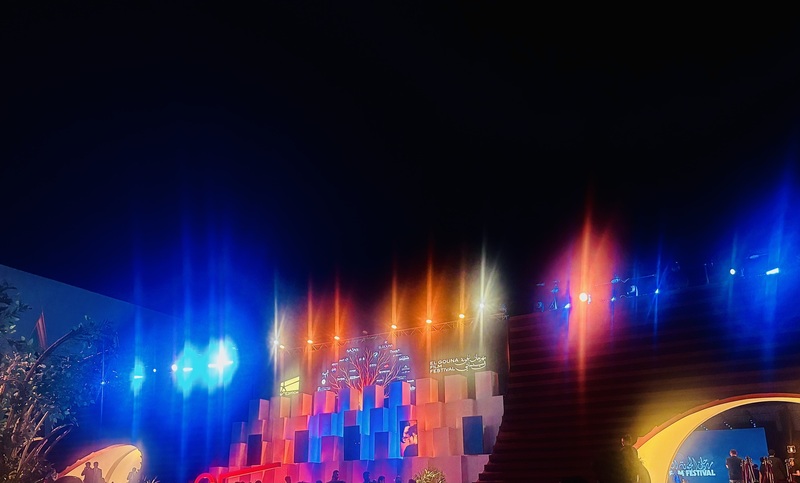
Not only as an Egyptian production at a festival created as a local investment incentive, Mohamed Hammad's Safe Exit is a fitting winner for the 9th El Gouna Film Festival. The laconic drama, selected by the jury under the presidency of British director Joanna Hogg, proved a literal secure way out as a predictable choice for an event presenting itself as a showcase of Arab cinema. But what relevance films and their creators actually have seems questionable at a celebration ready to exclude the very talents that make up its selection and even receive awards. If these weren’t accepted in person at yesterday’s awards ceremony, it’s not necessarily because of GFF’s inconvenient position on the international festival agenda and lack of renown.
More likely, the supposedly cherished visitors never got to the posh vacation vicinity in time or at all, given the festival’s visible reluctance to actually provide the flights they so generously promised. Those who consider themselves lucky to have arrived in the upscale resort that one filmmaker from the competition refers to as ”plastic town”, might think twice when suddenly not their airplane but the chances to continue their work trip are up in the air. The fact is that privately shelling out the money to buy a last-minute flight might not be a viable option for the majority of notoriously under- and unpaid film journalists, especially for those from disadvantaged backgrounds.
But El Gouna might just be the last place to have comprehension or even consideration for those outside the privileged crowd of mostly European vacationers and predominantly local screen stars and prominent personalities. Invitees are housed in luxury hotels, fenced off from the residential population who only seem to enter for work. A whole essay fit for the festival’s short film competition could be filmed about this weird world of wealth where the comfortable clientele are wheeled around in golf carts, diverted by evening entertainment, and constantly surrounded by most probable contract-enforced cheerfulness (everyone who’s ever worked in the service industry knows, tending to a melee of monied middle-class people isn’t that fun).
The awards ceremony becomes a prime example of elitist exclusivity with a black-tie dress code enforced with wilful rigour. Some men are sent away for not sporting bow ties or neckties while others can enter in trainers and T-shirts. Several female guests are barred for not wearing dresses while others are good to go in granny trausers. This classist comedy will reach its peak when to get inside, the director of a competition film has to argue for half an hour with security who insist her long black evening dress “is not a dress”. Later sad director will accept an award on stage and their selfcomposure is just admirably. Even press are subjected to this surreal selective scrutiny, as if any glimpse of lower-class life would be offensive. Unless it’s at the safe distance of the screen.
There, Yukiko Sode's All the Lovers in the Night won a Silver Star, with Bronze going to Ali Asgari's tragicomical snapshot of suicidal ideation A Bit of Light. Best Arabic Feature prize went to Rakan Miassi's hybrid docu-drama Yesterday the Eye Didn't Sleep, and a special mention to Moroccan Yassine Idrissi’s nuanced portrait of rural elderly hashish trader Halima. One part of the binary Best Performance prize honoured Jovan Ginic for 3 Weeks After; the other half went to Jordanian actress Rakeen Saad, near unrecognizable as hardened gang member Boomah. It’s again a pronounced focus on works from Arab countries traditionally overlooked at Eurocentric film festivals and continues throughout the hard-hitting non-fiction slate.
Ahmed Hassouna's Citizen Osama won the documentary Golden Star for following a Palestinian journalist in northern Gaza through the first year of his son's life. Dongnan Chen’s gentle coming-of-age tale Whispers in May took the Silver Star and the historic chronicle of misogynistic repression under the mask of morality, War on Women, the Bronze Star (with one unnamed jury member dissenting, which in itself is a rare occurrence at film festivals). As prestigious and prominent as the selection was, world premieres were the exception to a rule of established festival highlights. Thus, the coveted A-list seal eludes El Gouna, which still has to make its mark on the global festival map.
Mansi’s evocation of Cannes as a model provokes the question of what aspects of that French festival institution El Gouna actually aims for. World-famous stars, glamorous premieres, and a patriarchal power apparatus predictably reaffirming itself? It all seems achievable in a scripted scenario where the international festival circuit is used as a readily accessible video store to advertise the very system its most relevant titles aim to overcome. A festival’s true potential is to overcome social divisions based upon status, wealth, gender, and background. A film festival fulfilling its purpose would break up that elitist enclave catered to by Nespresso, Armani, Pepsi, & co. in favour of a gate-free gathering that doesn’t demand people hide their identity behind expensive clothes.
Mit deiner Zustimmung verwenden wir Google Analytics, um zu verstehen, welche öffentlichen Inhalte gelesen werden. Dabei werden Informationen über deinen Besuch an Google übermittelt und Analyse-Cookies gesetzt. Ohne Zustimmung wird Google Analytics nicht geladen.
Deine Entscheidung ist freiwillig und kann jederzeit über „Analyse-Einstellungen“ geändert werden. Mehr zum Datenschutz

 Bildnachweis: © MB

