
SIFF 2026 Recap: Art, AI, and little Access

Von Lidanoir in 28th Shanghai International Film Festival
 Bildnachweis: © MB
“Cinema is the art of dreaming, and Shanghai is the very vessel on which the Chinese film dream set sail.” It’s a wonderfully illustrious statement with which Tony Leung introduced the 2026 Shanghai International Film Festival (SIFF), at which he served as head of the jury, cleverly balancing promotion and profitability prospects with that slight touch of poetry. Dreamlike it may seem indeed to visit one of Asia’s top five film festivals. Or maybe even top three, considering SIFF’s fierce competition with the Hong Kong International Film Festival. The first two places go undisputed to Busan and Tokyo, which have what Shanghai is still struggling with: an international presence that transcends the title.
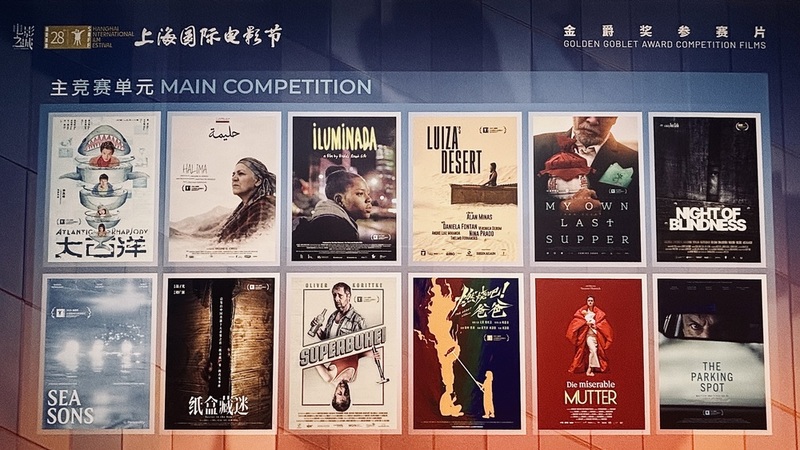
On an artistic level, that hurdle is cleared. The 12 main competition titles represented 15 nations and territories—thanks to co-productions—while the dozen titles of the most important side section, Asian New Talent, featured 18 countries. The Golden Goblets aimed for a strategic balance between emphasizing the international scope and hailing Chinese cinema. Zhong Kaifeng’s formally audacious Atlantic Rhapsody took the prize for Best Feature Film, boosted by DoP Hao Jiayue winning Best Cinematography. The Jury Grand Prix went to Nicolás Rincón Gille’s socio-conscious story of spiritual self-awakening, Iluminada. Morocco’s politically poignant mix of character portrait and cannabis drama, Halima, became the second big winner, earning a Best Director award for Yassine El Idrissi and Best Actress for Khadija Amari.
Zhang Songwen took the Best Actor trophy for his performance in Frankie Tam’s gritty murder mystery Secret in the Box. Best Screenplay went to Reis Çelik’s autobiographically inspired parable Night of Blindness. In the Asian New Talent competition, Gong Yiwen's Her First Taste won Best Film. While the broad range of different genres and styles was a refreshing diversion from many European festivals' fixation on heavy drama, the absence of diversity felt jarring. Only three of the 24 titles from the key competitions were directed by women. Not one single title came from a Black filmmaker or centered on the queer experience, including the 10 films from the Animation and Documentary slates.
Hardly any LGBTQIA+-themed films made it among the major program’s 420+ titles from 77 nations and territories, comprising one of the largest editions in the festival’s history. According to official reports, hundreds of thousands of tickets sold out within minutes. However, even the sold-out screenings at the busy festival hub at the Shanghai Film Art Center were curiously underpopulated, a contradiction that can’t be written off to the rigid ticketing system. Physical tickets are obligatory, canceling tickets is impossible, and despite seat assignments, misplaced physical tickets can’t be printed out a second time.
These unnecessary and, in a hyper-digitalized society, weirdly anachronistic complications add to the challenges of press work at SIFF. Press screenings don’t exist, neither does badge access to public screenings or press materials. Journalists have a tiny number of free tickets per festival that don’t even cover the main competition. Viewing the most essential titles alone turns into a—considering the physical tickets—literal paper chase. It’s a deplorable situation, especially for the filmmakers who hardly get the deserved attention. The latter goes mostly to the press conferences, which the lack of critical questions turns into something closer to publicity events. This results in a stark absence of critical discussions and film reviews.
International festival coverage is largely reduced to a slim number of generic pieces that mostly read like reassembled SIFF promotional publications, spat out by ChatGPT. It’s a sad irony, given that AI was claimed to have been a major talking point. Or was that only a misconception from the same algorithm that generated far too many texts at SIFF? “There’s no soul in it,” Tony Leung observed about AI, and he couldn’t be more correct regarding the generic pieces that increasingly dominate all spectrums of film reception, not only in Shanghai. There, the state of cinema proves highly ambiguous. A program full of promising debuts and astute works receives next to no coverage.
Unfavorable working conditions should be at least partly responsible. Despite the festival’s highlighted international focus, even English translation is mostly missing. This also goes for the Q&As after premieres and masterclasses, such as that given by Tony Leung, who also provided the festival’s most accurate prospective: “Too much hope usually disappoints people.”
Here are the winners of Shanghai International Film Festival 2026..

Wird geladen...