
×
Erwähnungen
Lisandro Alonso: "This story is about the consequences of vanishing institutional responsibility"

Von Lidanoir in Interview with Lisandro Alonso on "Double Freedom"
am Sonntag, 08 November 2026, 14:21 Uhr
- 0
- 0
 Bildnachweis: © TIFF JP 2026
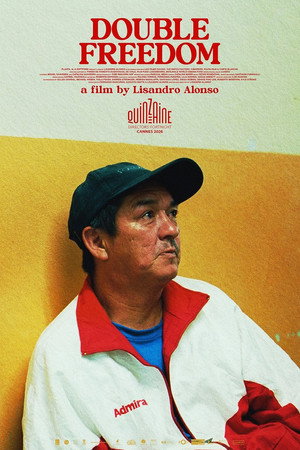
More than two decades after exploring his protagonist Misael Saavedra's radical search for individual Independence in Freedom, Argentine filmmaker Lisandro Alonso returns to the character of his debut feature in his latest work Double Freedom. His stark portrait of an initially solitary life in the wilderness merges with a subtle exploration of family bonds and mental illness in a society struggling under the systemic dismanteling of health care and institutional support structures. At the Tokyo International Film Festival where Double Freedom celebrates its Asian premiere, the director discusses the origins of the sequel, the collaboration with his actors, and the social and political realities that inform the film.
Lida Bach: What inspired you to make a sequel to La Libertad (2001), and to revisit its protagonist, Misael Saavedra, 25 years later?
Lisandro Alonso: I began developing the screenplay after finishing the shoot of Eureka, but before its release. That had been a very large-scale production, filmed in five countries with a substantial crew. After that experience, I wanted to return to a much simpler way of making films. I had also wanted for a long time to revisit Misael, who was the subject of my first film and, in a sense, my first love. I was curious about what his life would look like 20 years later.
The starting point was quite simple: after spending 25 years working in the woods, Misael learns that his sister, who has been living in a psychiatric institution, is about to be released. He must take her in and look after her. This premise gave us a way to return to Misael while exploring a subject that affects many families: how to care for someone with a mental illness. What can you do to help? Is it even possible to help? These were questions that emerged from personal experiences and from situations involving people we knew.
LB: The film brings together two people with very different backgrounds and ways of life. How did you approach the relationship between Misael and his sister?
LA: Initially, we imagined the story as something quite dark and tragic. Misael had spent his life in the wilderness, living in isolation, while his sister had been confined to the very restricted environment of an institution. We thought that her arrival would disrupt his freedom. He would have to be constantly alert to her needs and responsibilities. The hospital sequence makes this clear: he is told that he must take her back for medication every month and that he cannot simply leave her alone in the woods. His former way of life suddenly seems impossible.
But as we developed the screenplay, we began to realize that the story was not only about Misael losing his freedom. It was also about his sister gaining hers. We became interested in following both journeys: how each of them reacts to the other and how their relationship changes them. That shift made the story more luminous. When Misael goes shopping and buys her a Fanta, for instance, her reaction suggests that she has not had one in years. He also treats her with considerable respect. When she asks whether the things around him belong to him, he does not simply dismiss her question. And when she says the birds are welcoming her, he agrees that perhaps they are. These gestures reveal a growing tenderness between them.
Some comedy also emerged through the actors' performances. We had an expression during the writing process: you cannot cure this kind of illness with mate and hugs. But the film gradually became less tragic than we had originally imagined.
LB: Did the screenplay change substantially during production, or was the finished film close to what you had originally written?
LA: The screenplay did not change dramatically in its final form. Rather, the writing process itself led us to discover nuances that had not been apparent at the beginning. We had many conversations and brought personal experiences into the development of the story.
The most important change was our understanding of the relationship between the two characters. It all became a story about two people discovering one another. To this development, the actors contributed enormously. Misael is played by a non-professional actor, while Catalina is a professional actress. Their interpretations brought a different quality to the material. Although the basic structure remained the same, their performances made the film more open and luminous than the screenplay had suggested.
LB: The title suggests that both characters gain something through their encounter, and a certain unity. It’s not “Two Freedoms”, but Double Freedom…
LA: I don't want to give away too much, because it is deliberately ambiguous. Much of the film is open to interpretation. For example, some viewers may think that something bad will happen to Micaela after she leaves the screen later in the film. Others may imagine that the two siblings will eventually reunite, perhaps even that very same afternoon. What matters is what the film provokes in each spectator and what personal experiences they bring to it. I prefer to leave that question open to interpretation.
LB: Since Misael is being revisited 25 years after the first film, should the many shots of clocks and watches be understood as references to the passage of time?
LA: That was not our primary intention. The watch that Micaela finds represents something that Misael has lost, something she may be able to bring back into his life.
Misael has an intimate knowledge of the wilderness. He knows how to thrive in it and can recognize things in his surroundings to which other people would be oblivious. But he and Micaela perceive the same environment differently. She notices things that he no longer sees, just as he has a particular relationship with the landscape that she does not share. There is also a recurring moment in which Micaela asks Misael what time it is. At first, it seems like something a younger sister might do simply to annoy her brother. Only toward the end do we understand why she keeps asking. Of course, viewers are free to interpret the watch and the repeated references to time in other ways, including as reflections on the passage of time.
LB: Are the story’s events in part also a critique of the severe cuts in public funding, including the already neglected psychiatric institutions, by Javier Milei and his government?
LA: Actually, the film was developed before Javier Milei's presidency and the recent cuts to public spending in Argentina. It reflects a broader situation that’s not just specific to our country. Across South America and elsewhere, governments are withdrawing financial support from institutions that are responsible for caring for vulnerable individuals. When these facilities lose their funding, patients can be left without adequate care and families are forced to take responsibility.
Initially, we had planned to film the institutional scenes in an actual psychiatric institution. We visited one and obtained permission from its director. At a place like this, you hear these sounds that are almost impossible to describe, it’s something that you cannot simply evoke something like this through acting. It’s a haunting experience.
However, the director subsequently changed, and we lost access to the facility. So the only choice we had was to recreated the entire sequence cinematically in a constructed setting. But during our research, we still learned a lot about facilities struggling with insufficient funding, staff shortages, and inadequate resources. The situation depicted is particularly troubling because patients are often just barely kept alive and are constantly sedated with medication, without much consideration for their individual identities or needs.
Still, the doctors and nurses we encountered were doing their best under extremely difficult circumstances. They’re not the villains; they’re trying to provide care with very limited resources. The doctors are overwhelmed, and the priority becomes maintaining patients in a stable condition.
LB: Nevertheless, the depiction of the withdrawal of support for healthcare institutions seems particularly relevant today. Was this political context a conscious consideration?
LA: We were aware of what was happening, but the film is not intended as a direct denunciation of the current government. Actually, I began writing it before these developments. The issue is also much broader than Argentina: governments in many countries are withdrawing support from public services and leaving individuals and families to deal with the consequences.
There is a moment when Misael listens to the radio, but he is not tuning in to the news; he listens to the song "Copacabana". Within that scene, there is something about the distance between political decisions and the lives of ordinary people. Governments make decisions without necessarily considering their real consequences for those who depend on public assistance. Whatever politicians might say, the people affected by these decisions continue to struggle, often without support. Micaela and Misael's story is about those consequences of vanishing institutional responsibility, when the burden of care falls back on families.
LB: Thank you for the interview!
Wird geladen...
{{ loadError }}