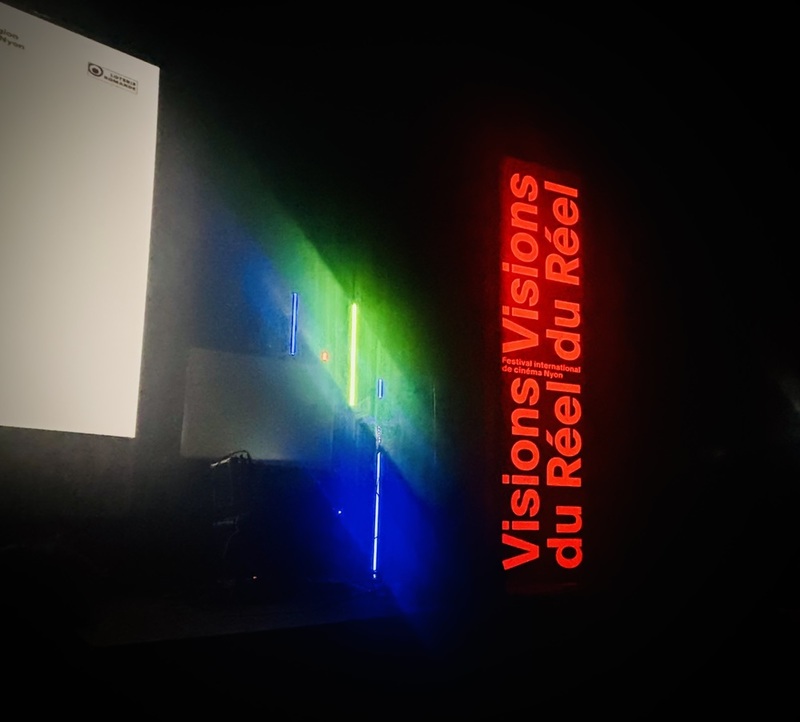
Changes seem overdue at Visions du Réel, as the festival's 57th edition closing today proved once again. The question is if the new direction succeeding artistic director Emilie Bujès, who departs after nine years with the festival, will be ready to make them. The future position is yet to be filled, so if you feel competent, go and apply. It would be a lot of work, though, to pull the event out of its secure state of middlebrow mediocrity. This comfortable but constrictive state is underscored by a film program the highlights of which hail from Sundance, CPH:DOX, and even the Berlinale (not particularly renowned for its documentary slate). Even Laura Poitras’ prestigious opening film Cover-up debuted in Venice half a year ago and was already widely available.
Then again, Giulia Montineri’s documentarist look at femicide #SainteJulie through a collection of vox pops constituted something of an unofficial opening film, screening as a “pre-premiere” (what?) one day before the festival officially opened on the 17th. A curious decision, emblematic of the festival’s wavering between audience-focused ambition and arthouse academicism. More prevalent among the film selection was the latter. Personal perspectives, meditative meandering, and self-centered stories appeared to supersede hard-hitting investigations and topical documentaries. Awards reaffirmed this transition. Spanish-Chinese director Xisi Sofia Ye Chen’s biography of her brother, Dawn to Dawn, won the International Feature Film Competition’s Grand Prize. Marlene Edoyan earned the Jury’s Special Prize for A Fire There, a triptych of young masculinity in rural Georgia.
A Special Mention went to Boubacar Sangaré’s Djeliya, mémoire du Mandé, while the Special Jury Award graced Nông Nhât Quang’s engaging first cinematic feature documentary Baby Jackfruit Baby Guava. Lauren Dällenbach’s Nicole Nicole about codependency in a mother-daughter household received the main prize in the National Competition. Both are family stories in a program overflowing with family tales, preferably told about the filmmakers’ own folks. Predictably, the Audience Award went also to a personal story, albeit one of lovers: Birds of War by Janay Boulos and Abd Alkader Habak chronicles a romance in the face of war and political upheaval. It’s the only one of the highlights from other festivals to receive an award, which indicates that quality may be only a minor criterion in the award decisions.
Many outstanding works, from Poh Si Teng’s gripping documentary American Doctor about medicine under siege in Gaza to Dongnan Chen’s delicate portrait of dissipating youth Whispers in May, and John Wilson’s cleverly humorous The History of Concrete, went away empty-handed. The feeling of being left out could be the bleak bottom line of an event that all too often appears as bourgeois, closed-off, and privileged as the majority of its audience; overwhelmingly white, overwhelmingly middle-class, middle-aged, and most likely academic. Debates hardly happen in this climate, though this issue is one affecting many documentary film festivals. Q&As remained short and tame, talks never allow for any real interaction among participants, and discussions are replaced by scripted laudations.
“Scripted” being a conspicuous cue, as the festival’s non-fiction focus is not only diluted by the clearly fictional narrative works in the retrospective program areas, but by an increased blurring of boundaries between documentary and staged cinematic forms. Docudrama, reality formats, and a palpable performative aspect in many films reflect an era in which facts and fiction become more and more interchangeable. In recent years, Visions du Réel went with this flow of filmic “faction”, incidentally losing an essential part of its conceptual clarity. That the change in direction will propose a new way to handle such developments remains a slender hope. Until then, the eclectic event continues as conformist and neat as its lifeless location.

 Bildnachweis: © MB